
Case study ·
Why Heavy Lift Payload Drones Matter for Defence Operations
By Shranto · 5 min read
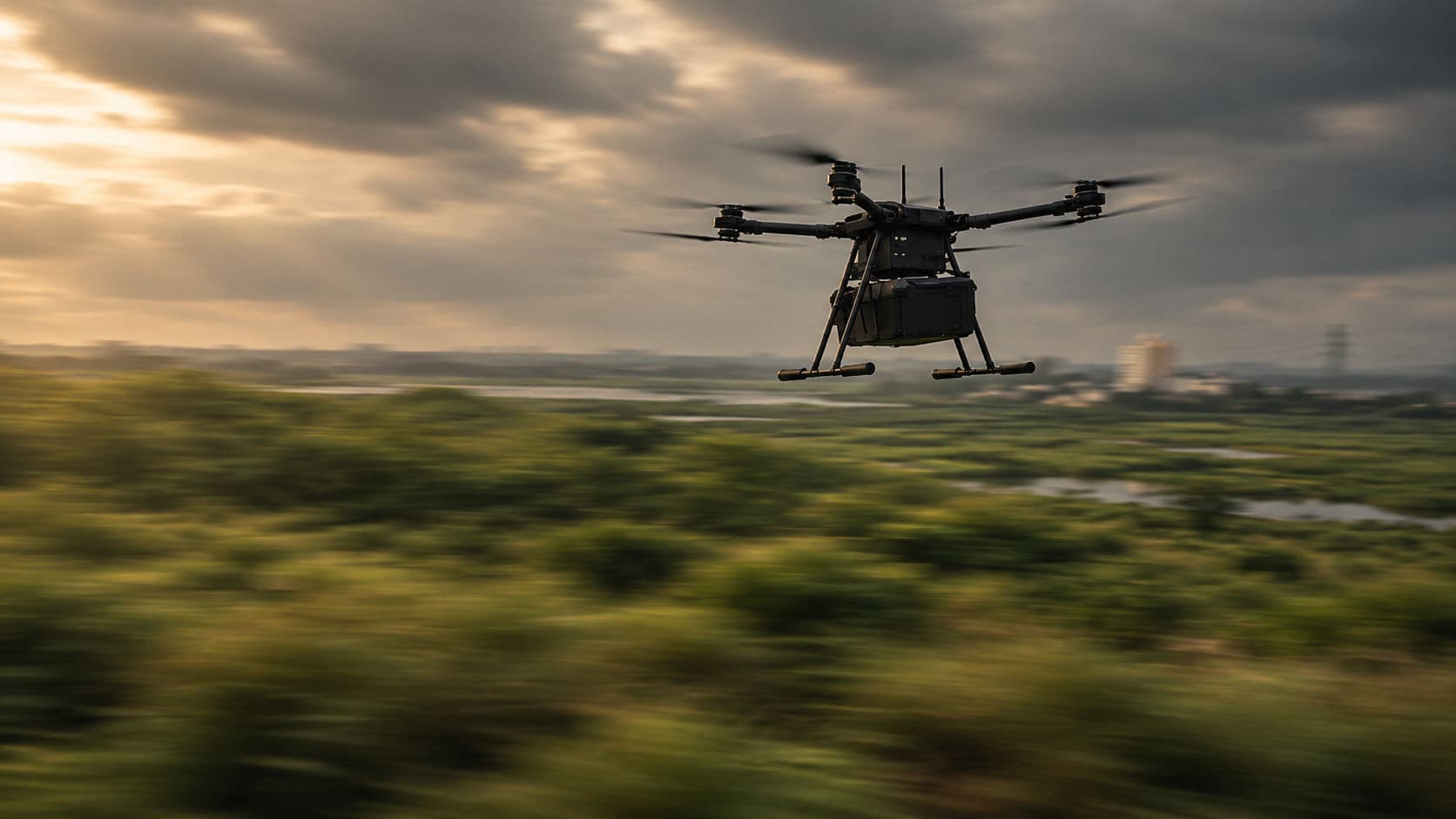
Defence organisations operate across river networks, coastal zones, remote border areas and dense urban environments. Weather, damaged roads or limited access can slow the movement of equipment at the moment it is needed. A heavy-lift unmanned aircraft gives commanders another way to move sensors, communication equipment, medical supplies or critical spare parts without immediately committing a crewed aircraft or sending personnel into an exposed location.
This is the operational value of a payload drone. Its importance comes from the useful equipment it can carry, the speed with which it can be reconfigured and the way it connects that equipment to the wider command structure. The aircraft must do more than lift weight. It must deliver a defined capability to the right location, keep the operator informed and return mission data in a usable form.
Payload capacity changes the mission
Dubotech’s Octocopter is a heavy-lift unmanned aerial platform designed around mission-specific payloads. Its eight-rotor configuration provides stable flight performance, while its modular architecture supports the integration of cameras, communication equipment and other specialised systems. With a payload capacity of up to 20 kilograms, the platform can carry equipment that smaller surveillance drones cannot accommodate.
That capacity opens several roles for military and government operators. The aircraft can move batteries, radios, medical items and essential supplies to an isolated post. It can carry electro-optical or thermal cameras for reconnaissance and surveillance. It can support mapping, inspection or communications relay missions when the appropriate payload is installed. During an emergency, the same platform can be reconfigured for rapid assessment or delivery rather than waiting for a separate aircraft to become available.
For Bangladesh, this flexibility is especially relevant. Riverine terrain, coastal islands and congested ground routes can make short-distance movement operationally difficult. A payload aircraft can complement helicopters, vehicles and boats by handling selected missions that require speed and access but do not justify the cost or exposure of a crewed platform.
Payload integration determines operational value
A useful payload system requires more than a mounting plate. The aircraft must provide the correct mechanical interface, electrical power, data connection and centre of gravity limits for each payload. Engineers must also account for electromagnetic compatibility, endurance, vibration, environmental exposure and the effect of payload weight on flight performance. These considerations determine whether a sensor or communications package will work reliably after takeoff.
Mission software is equally important. The operator should be able to plan the route, monitor the aircraft, control the payload where required and receive its information without moving between disconnected systems. A camera feed, for example, becomes more useful when it is linked to aircraft position, mission time and the wider operating picture. A delivery payload becomes more dependable when release conditions, location and completion status are visible to the mission commander.
This system's approach also protects future investment. A modular airframe can accept new sensors, radios or delivery mechanisms as requirements change. Defence organisations can develop capability through payloads and software instead of procuring a completely different drone for every task.
FORTIS connects the aircraft to the force
The Octocopter is connected to FORTIS, Dubotech’s sovereign autonomy and mission control platform. FORTIS plans missions, runs autonomy at the edge, fuses sensor data and maintains one operator picture across the fleet. For an aerial mission, this means the operator can define the objective, route and constraints, supervise autonomous flight execution, monitor platform health and manage payload information through a common environment.
The aircraft can therefore contribute to a coordinated operation rather than function as an isolated drone with a separate control station. Information gathered overhead can support land, maritime or fixed surveillance assets using the same operating picture. Mission status and payload data remain visible to the people responsible for the wider task, while the operator stays in command of the aircraft.
FORTIS is designed around five connected functions covering mission execution, inspection, surveillance, analytics and fleet management. Because those functions share the same data model, information can move from detection to tasking and reporting without being rebuilt in separate applications. The edge autonomy layer is also designed to maintain vehicle-level perception, planning and control when communications are degraded.
Sovereign capability supports long term readiness
For Bangladesh’s military organisations, sovereign autonomy has practical value. Local engineering teams can adapt interfaces for available sensors and radios, tune software around national operating conditions and support systems without depending entirely on a closed foreign ecosystem. This shortens the path from operator feedback to engineering change and gives defence users a clearer route for sustainment and future upgrades.
Dubotech has demonstrated its heavy-lift UAV to Bangladesh Army personnel, with attention to autonomous flight, adaptable payload integration and the connection between the aircraft and its mission-control environment. Direct engagement with operators is essential because real requirements emerge from deployment procedures, communications limits, weather, terrain and the way units organise a mission. Those lessons shape both the aircraft and the autonomy software behind it.
An adaptable platform for changing requirements
The case for a heavy-lift payload drone is ultimately based on adaptability. Bangladesh’s defence organisations need aerial systems that can support logistics today, accept a new sensor tomorrow and join a broader autonomous fleet as operational needs develop. Payload capacity provides room for that evolution, while modular integration determines how quickly the aircraft can take on a new role.
Dubotech’s Octocopter brings together stable eight-rotor flight, up to 20 kilograms of payload capacity and a modular architecture for mission-specific equipment. FORTIS adds mission planning, autonomous execution, platform monitoring and a shared operating picture. Together, they provide a foundation for logistics, reconnaissance, surveillance, inspection and rapid-response missions while keeping the operator at the centre of command.
More field stories from Dubotech.
View all